

How School Partnerships Work
A Flexible Assessment Model Built Around Your School’s Clinical Capacity
NVOX gives schools and districts two ways to use the same structured ADHD assessment framework.
Choose an NVOX doctoral-level psychologist for the final clinical review, or assign a qualified clinician from your own team to complete the review within NVOX.
In both models, information remains clearly sourced, the case is organized for professional review, and educational decisions remain with the school or district.
.webp)
Choose the Clinical Review Model
One Assessment Framework.
Two Options for Final Clinical Review.

Schools and districts choose who reviews the complete case, authorizes the clinical findings, and approves the final report.
Both pathways use the same structured NVOX assessment framework. NVOX operates within a clinical governance framework that includes MD oversight, while final clinical responsibility remains with the clinician assigned to the case.
NVOX Direct
NVOX assigns a doctoral-level psychologist with a PhD or PsyD and an active license in the state where the evaluation is provided.
The NVOX clinician:
.svg)
Reviews the complete case and available evidence
Examines differences between information sources
Determines and authorizes the final clinical findings
Approves the final report
Explains the findings to the parent or legal guardian
With appropriate authorization, the final report may be shared with the school psychologist or another designated student support professional. A professional review with the NVOX clinician may also be requested to discuss findings relevant to educational functioning and support planning.
Best suited for schools and districts seeking additional clinical capacity.
School or District Clinician Review
A qualified school or district clinician who meets NVOX eligibility and applicable state requirements reviews the case within the NVOX environment.
The designated clinician:
.svg)
Reviews the complete case and available evidence
Examines differences between information sources
Determines and authorizes the final clinical findings
Approves the final report
Communicates the findings through the school or district’s established process
Best suited for schools and districts that want to use the NVOX framework while retaining final clinical review within their own team.
Schools and districts can select the model that best reflects their staffing, professional capacity, internal policies, and preferred level of clinical involvement.
The Two Models at a Glance
Choose the Level of Clinical Support Your Team Needs



where the evaluation is provided
applicable state requirements
established process
authorization
permissions
permissions
Schools and districts can select the model that best reflects their staffing,
professional capacity, internal policies, and preferred level of clinical involvement.
How Information Is Collected
Family and School Perspectives Remain Separate, Visible, and Reviewable
Parents and educators observe the student in different environments and under different demands. NVOX collects these perspectives through separate, structured processes so that each source remains identifiable throughout the assessment.
Parent or Caregiver Input
The parent or primary caregiver provides structured information about developmental history, daily functioning, concerns at home, relevant clinical history, and difficulties observed outside the educational setting.
School-Based Observations
The school professional provides structured observations related to attention, organization, task initiation, work completion, regulation, participation, transitions, and supports that have already been attempted.
Available Documents and Prior Information
Relevant documents may be added to the record when available, including previous evaluations, clinical records, school information, and documentation of prior supports.
Assessment Evidence
Assessment task performance, functional information, behavioral observations, and other available evidence are organized within the same reviewable case record.
Parent and school information is not merged into a single undifferentiated narrative. Each source remains visible so that areas of agreement, difference, and missing information can be examined professionally.
Clinical Review, Family Feedback, and School Consultation
A Clear Path From Collected Information to Professional Understanding

Once the available information has been organized, the clinician responsible for the case reviews the complete record rather than relying on a questionnaire, score, or individual task result in isolation.
Complete Case Review
The responsible clinician examines the clinical history, functional information, parent and school observations, available documents, assessment evidence, differences between sources, and limitations in the available information.
Final Findings and Report Authorization
The responsible clinician determines the final clinical meaning of the evidence, authorizes the findings and recommendations, and approves the report.
Family Feedback
Through NVOX Direct, the NVOX psychologist explains the findings to the parent or legal guardian during a feedback session.
Through School or District Clinician Review, feedback is provided through the school or district’s established process.
Professional School Consultation
Through NVOX Direct, the school psychologist or another designated student support professional may request a professional review with the NVOX clinician when appropriate authorization is in place.
The discussion may address:
The educational meaning of the findings
Differences between home
and school observations
Documented areas of functional impact
The evidence supporting
school-related recommendations
Information limitations or areas
requiring continued review

Through School or District Clinician Review, professional consultation is
managed within the school or district’s established process.
The purpose of professional consultation is to make the findings easier to understand and consider within the school’s process. Educational decision-making authority remains with the school or district.
Role-Based Access and NVOX Whisper™
The Right Information and Questions for Each Professional Role
When NVOX Whisper becomes available, access to case information through the feature will be permission-based and tailored to the user’s professional role.
When available, NVOX Whisper (Coming Soon) will allow authorized users to ask case-specific questions and receive professionally grounded answers based on the evidence and clinician-authorized findings and recommendations within the record.

For School Psychologists and Student Support Professionals
When available, authorized professionals will be able to examine differences between sources, functional findings, the evidence supporting recommendations, and limitations in the available information.
Example Questions
.svg)
Where do the parent and school observations converge,
and where do they differ?
Which findings are most relevant to independent work,
testing conditions, or transitions?
What evidence supports the recommendations
related to school functioning?
What information limitations should be considered when reviewing this case?
.svg)
For Teachers and Educators
When available, educators will be able to receive role-appropriate guidance focused on classroom functioning, information available to them, practical implementation, and areas for continued observation.
Example Questions
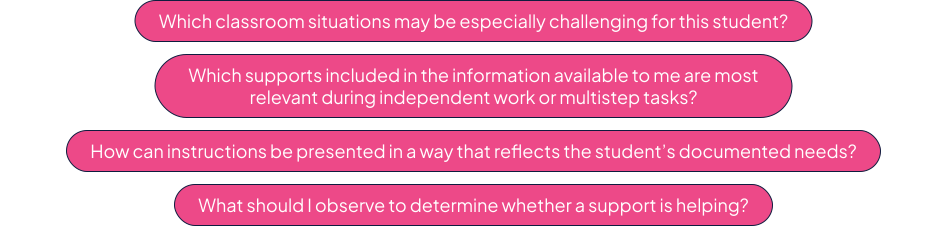
Which classroom situations may be especially challenging for this student?
Which supports included in the information available to me are most relevant during independent work or multistep tasks?
How can instructions be presented in a way that reflects the
student’s documented needs?
What should I observe to determine whether a support is helping?
.svg)
Family Feedback and Report Access
Parents or legal guardians will receive feedback through the process established for the selected clinical pathway. Access to and sharing of the report will follow the applicable authorizations and the requirements of the school or district.
Educational Decisions Remain With the School
Clinical Evidence Can Support the Process Without Controlling the Outcome

An NVOX report adds clinical and functional context that may be considered alongside school data, academic performance, staff observations, previous interventions, the student’s response to support, and other relevant information.
The report supports the school’s process. It does not replace the school or district’s educational evaluation or decision-making responsibilities.
An ADHD diagnosis may provide important information, but it does not by itself determine eligibility for a 504 Plan, an IEP, services, or a particular accommodation.
The school or district remains responsible for:

Educational evaluation process
Determining whether additional
information is needed
Eligibility decisions
Services and accommodations
Support planning and implementation
Monitoring the student’s response to support
NVOX supports professional review and educational planning. Each school or district determines how to consider a report produced through NVOX within its own educational evaluation and support process.
Build the Model That Fits Your Team
Let’s Discuss Your Capacity, Workflow, and Student Support Needs
NVOX can work with schools and districts seeking additional clinical capacity, as well as organizations that want their own qualified clinicians to complete the final review.
Tell us about your current process, staffing model, assessment needs, and implementation goals. The NVOX team will review your inquiry and discuss the most appropriate pathway.